
Reviewed · OLD CITY TOURS
Guided Old City Tour on Baku’s Timeless Charm
Baku’s oldest quarter rewards curious walkers. This two-hour tour takes you through Icherisheher, the walled UNESCO-listed center of Baku, with a local guide explaining the forts, caravanserais, mosques, baths, palaces, and legends behind the stone streets. I like the compact route, which covers an impressive number of landmarks without requiring transport, and I like the small maximum group size of 15, which should make it easier to hear the guide and ask questions.
The tour also does a good job of looking beyond the two famous sights. You see the Maiden Tower and Palace of the Shirvanshahs, but you also pass old merchant courtyards, a medieval bath, a miniature-book museum, an artist’s workshop, and the remains of religious buildings. The main thing to consider is pace: 18 stops in about two hours means many visits are brief, and admission to the Maiden Tower and Shirvanshah Palace costs extra.
In This Review
- Key points to know before you book
- Why this two-hour walk works in Baku
- Gosha Gala Square and the Double Gates
- Caravanserais built for medieval trade
- The Maiden Tower and Bazar Square
- St. Bartholomew Church and medieval baths
- Mosques and smaller caravanserais
- A poet, tiny books, and a working art studio
- The Shirvanshah Palace and Beyler Mosque
- What $25 buys you
- Timing, meeting point, and practical details
- Who should book this Old City walk?
- Should you book it?
- FAQ
- How long does the Baku Old City tour last?
- Where does the tour begin and end?
- What is included in the price?
- Is admission to the Maiden Tower included?
- Is admission to the Palace of the Shirvanshahs included?
- What is the maximum group size?
Key points to know before you book
- Two hours inside the fortress walls: The route begins and ends at Gosha Gala Square, keeping the focus firmly on Baku’s historic core.
- A strong mix of famous and lesser-known sights: The Maiden Tower and Shirvanshah Palace share the route with caravanserais, baths, a miniature-book museum, and an artist’s studio.
- Admission is not fully covered: The two principal paid sights are listed with admission excluded, while most other stops are outdoor or free-access visits.
- A maximum of 15 people: This is not a huge coach excursion, so the guide can offer a more personal walking experience.
- Good value at $25 per person: The price is reasonable if you want an introduction to the Old City and do not need long interior visits.
- Free cancellation up to 24 hours ahead: You can receive a full refund if you cancel at least one day before the start time.
Why this two-hour walk works in Baku
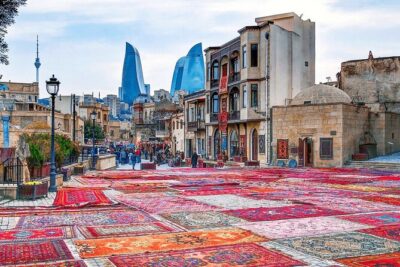
I like starting with Icherisheher because Baku can feel surprisingly modern outside the walls. Glass towers, wide boulevards, and grand seaside projects give the capital a new face, while the Old City compresses centuries into a small, walkable area.
The route is designed as an orientation walk rather than a full archaeological study. You move from gate to courtyard, from mosque to bathhouse, with the guide providing the links between them. That approach is especially useful on a first day in Baku, when the winding lanes can be difficult to read on your own.
The schedule is busy. Some stops receive only two or three minutes, while the Maiden Tower gets 10 minutes, the miniature-book museum 10 minutes, and the Shirvanshah Palace 20 minutes. Those times suggest that you will see many places from the outside and hear their stories, but you will not have time to study every carved stone or browse each room at leisure.
That is not necessarily a weakness. A short, well-planned walk can help you decide where to return later. If you want a slower museum visit, treat this tour as your introduction and plan a separate visit to the two major paid sites.
Other walks inside the walled old city:
- Baku Oil Heritage & Old Town Walking Tour
★ 5.0 · 232 reviews - Guba Khinalug & Candy Cane Mountains tour (by Old City Tours)
★ 4.5 · 208 reviews - Gabala + Shamakhi tour (by Old City Tours)
★ 4.5 · 198 reviews
Gosha Gala Square and the Double Gates
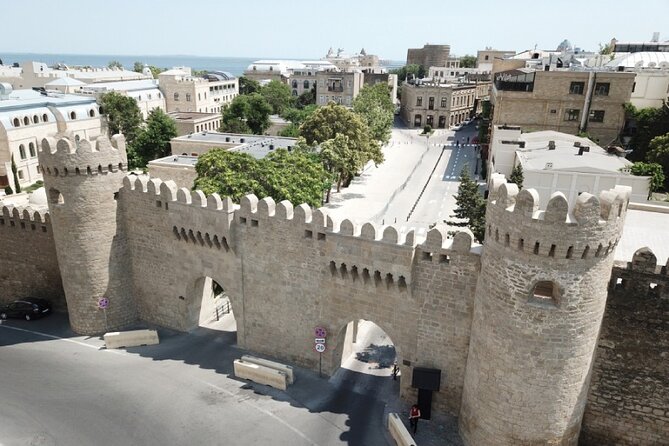
The meeting point is Gosha Gala Square at 47 Kichik Qala. Gosha Gala means Double Gates, and these fortified entrances provide a fitting start to the walk.
The gates date to the 12th century and formed part of Baku’s defensive system. They also help you understand the physical character of the Old City: thick walls, controlled entrances, narrow lanes, and buildings arranged around protected courtyards.
Only about two minutes are assigned here, so expect a short explanation and time to get oriented rather than a formal visit. Take a quick look at the stonework, note the route back to the square, and listen for the guide’s explanation of how the gate served the fortified settlement.
Because the tour returns to this same meeting point, you do not need to worry about finding your way to another part of Baku at the end.
Caravanserais built for medieval trade
The Bukhara Caravanserai and Multani Caravanserai offer some of the best context on the route. These were not palaces built only for rulers. They were practical places for merchants, animals, goods, and long-distance trade.
The Bukhara Caravanserai was built at the end of the 15th century on a commercial road through the Old City. Its square courtyard, raised portal, perimeter balconies, and small private rooms formed a sheltered place for merchants to meet after a day of trade.
The Multani Caravanserai dates to the 14th century and sits opposite the Bukhara building. It housed merchants from Multan, now in Pakistan, who came to the region for commerce. Zoroastrian traders are also associated with the building and with the Ateshgah Temple at Surakhani.
You are likely to appreciate these stops if you enjoy seeing how ordinary economic life shaped a city. The courtyards are easy to overlook when you are focused on grand monuments, yet they explain why Baku mattered on regional trade routes.
Both stops are listed as free, with roughly two minutes at each. That is enough to identify the layout and hear the main story, but not enough for a long architectural inspection.
The Maiden Tower and Bazar Square
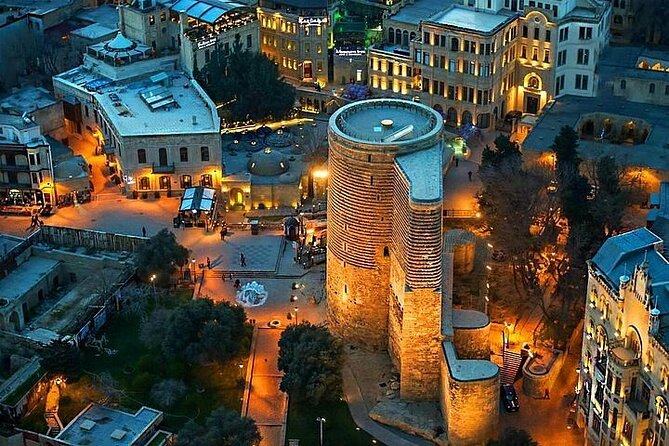
The Maiden Tower is the visual anchor of the first half of the tour. This 12th-century monument is one of Azerbaijan’s best-known symbols and appears on the country’s currency and official letterheads.
Its purpose and origins have prompted several interpretations. Some archaeological and architectural theories connect it to pre-Islamic or Zoroastrian traditions, while its later place in the Islamic Old City reflects the layers of Baku’s past. A good guide can explain these ideas without pretending that every question has one certain answer.
Ten minutes is allocated here, and admission is not included. That distinction matters. The tour gives you the setting, explanation, and time for a short look, but you should budget separately if you want to enter.
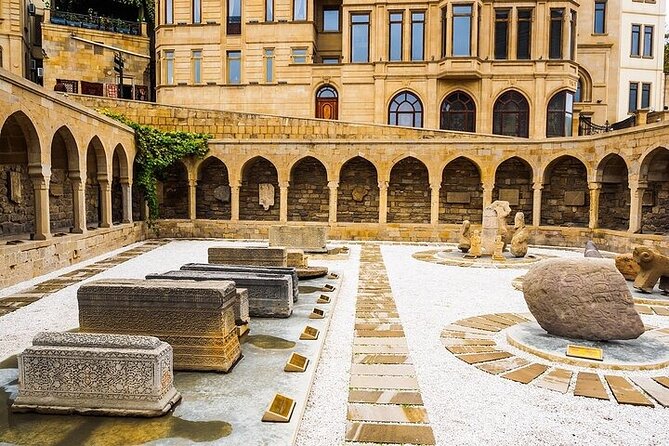
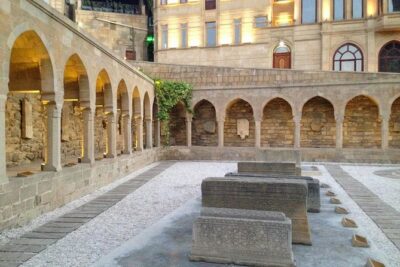
Near the tower, Bazar Square and the Khanqah complex reveal another part of the Old City. The religious and architectural complex dates from the 12th and 13th centuries and was found during archaeological work in 1964. It sits on Kichik Gala Street, close to the tower.
This is a good place to pay attention to the ground and surrounding walls. Archaeological remains in Baku often appear within the modern walking route rather than behind a grand museum entrance.
A few more Baku trips worth lining up next to this one
- Baku: Gobustan, Mud Volcano, Fire Mount, Temple Lunch Entry
★ 4.9 · 3,246 reviews - Baku: Guba, Shahdag, Laza & Lunch w/ Free City & Night Tour
★ 4.8 · 1,455 reviews - BEST Gobustan, Volcanoes & Absheron Fire Tour (Group or Private)
★ 5.0 · 1,254 reviews - Gobustan and Absheron tour (All inclusive)
★ 5.0 · 1,014 reviews
St. Bartholomew Church and medieval baths
St. Bartholomew Church adds a Christian chapter to the walk. Built in 1892 through donations from Baku’s local Christian community, it stood on a site associated with the Apostle Bartholomew, who was believed to have been killed near the Maiden Tower in 71 AD.
The small church followed the style of Russian Orthodox buildings and contained icons of Bartholomew and other saints. It operated until 1936, when it was demolished during the anti-religious campaign of the period. The stop is brief, but the story shows that the Old City’s religious past was never limited to one tradition.
The Haji Ghayib, or Haji Bani, Bath is a more substantial architectural stop. Built at the end of the 15th century, it was discovered underground during archaeological research in 1964. Its domed rooms and connected spaces reflect the importance of public baths in Muslim urban life.
You may notice how much attention the old builders gave to practical systems. The bath’s forms were not merely decorative. They organized changing areas, washing rooms, water, heat, and movement through the building.
The tour then passes the two-storey Gasim Bey Caravanserai, also called the Gasim Bey Caravanserai. It is a 15th-century monument associated with the period of Shirvanshah I Khalilullah and later with Gasim Bey and his heirs after Baku became part of the Russian Empire.
Again, the stop is short. Think of it as a visual lesson in how the Old City reused buildings over time.
Mosques and smaller caravanserais
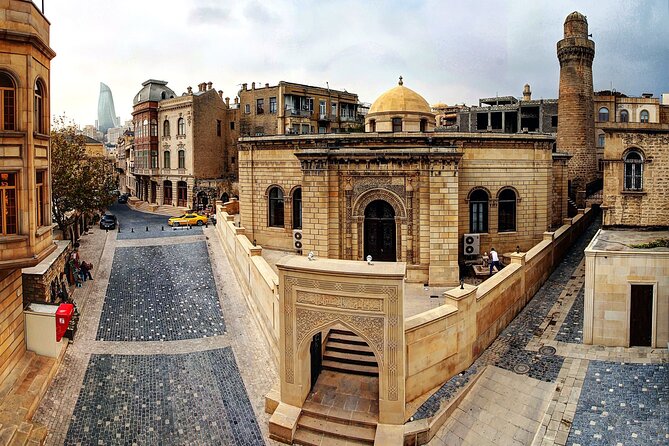
The Juma Mosque is one of the key religious landmarks along the route. An inscription records restoration ordered in 1309, and a minaret balcony was added in 1437. The present mosque was built in 1899 with financing from Haji Shikhlali Dadashov, a Baku merchant and philanthropist.
The site may also preserve traces of an earlier Zoroastrian temple. That detail helps explain why the city’s sacred places cannot always be placed into neat categories. Baku developed through successive faiths, rulers, and communities.
The Small Caravanserai gives you another look at medieval commercial architecture. Its square plan, cut corners, inner courtyard, long balcony, and portal-shaped entrances show how these buildings balanced trade with protection.
The northern and southern entrances once connected the building to different directions of movement, including access from the sea during the Middle Ages. The southern side had two floors and a defensive character, a reminder that commercial buildings also had to survive uncertain times.
The Gasim Bey Bath, also called the Sweet Bath, dates to the 17th century. Sweets and tea were served to bathers, giving the building its friendly nickname. Its design included an entrance, changing area, bathing rooms, pools, and a boiler room, with ceramic tubes helping carry water and heat beneath the floors and through the walls.
The bath was reconstructed in 1970 and converted into a pharmacy known as the Green Pharmacy. It is a useful stop for understanding that historic buildings do not always remain frozen in their original use.
A poet, tiny books, and a working art studio
The Aliagha Vahid Monument honors an Azerbaijani poet and ghazal singer who lived from 1895 to 1965. Created in 1990, it was designed and sculpted by Rahib Hasanov, with Sanan Salamzade as architect.
The monument gives the walk a modern cultural note. After so many medieval walls and religious buildings, you encounter a figure connected to Azerbaijan’s literary life.
The Baku Museum of Miniature Books is one of the most unusual stops. It opened in 2002 and holds more than 6,500 miniature books from 64 countries. The collection was assembled over 30 years by Zarifa Salahova, the sister of artist Tahir Salahov.
The museum received a Guinness Book of Records certificate in 2015 as the largest private museum of miniature books. Ten minutes is assigned here, and admission is listed as free. That is enough time to see the concept and some of the collection, though book lovers may want to return independently.
The Workshop Ali Shamsi adds a personal artistic touch. It functions as an art studio and a place to see the work of Azerbaijani artist Ali Shamsi. Shamsi studied at an arts-focused boarding school, graduated from the Azerbaijan State Institute of Arts in 1985, and later spent time in a monastery near Kharkiv, where he worked on icon painting.
This stop can feel different from the formal monuments. Instead of only hearing about the past, you see a living creative practice in the middle of the Old City. Ten minutes gives the guide room to introduce the artist and the space without turning the tour into a lengthy gallery visit.
The Shirvanshah Palace and Beyler Mosque
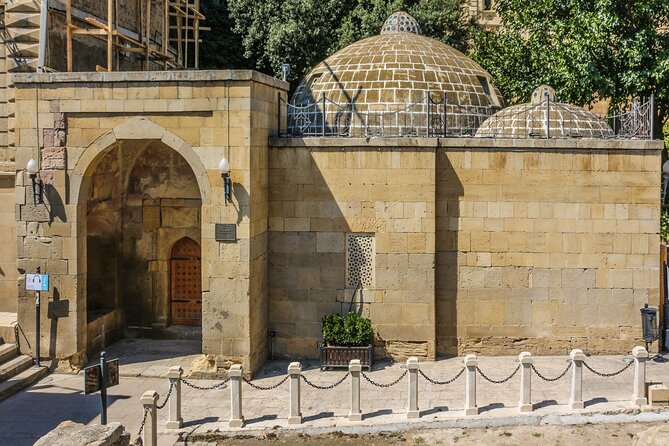
The Palace of the Shirvanshahs is the grand finale. Built in the 15th century after the Shirvanshah dynasty moved its capital from Shemakha to Baku, the complex includes one of the finest examples of Azerbaijan’s historic architecture.
The palace forms a UNESCO-listed group with the Maiden Tower. Its importance is not just visual. It represents the moment when Baku became the seat of the Shirvanshah rulers and received a major building program suited to a capital.
Twenty minutes is assigned here, the longest stop on the route. Admission is not included, so confirm the current entry charge when booking or before the walk. If you have only one paid interior visit in mind, this is likely the stronger choice for architecture and royal history.
Across from the Murad Gate of the palace complex, the Beyler Mosque provides a final religious monument. It is recognized as a historical and architectural monument of national importance, and its position opposite the palace makes the relationship between political and religious buildings easy to see.
The tour then continues to the Quadrangular Tower, one of the unusual surviving features of Baku’s fortress walls. The city once had two major walls on its northern, eastern, and western sides. After repeated damage and later restoration, 25 semicircular towers and one quadrangular tower remained.
The tower, also described as a donjon or armory, is a practical closing image for the walk. You finish with the defensive structure that helped shape the Old City in the first place.
What $25 buys you
At $25 per person, this is a sensible price for a guided introduction to Baku’s central historic quarter. You are paying for a professional guide, a planned route, and the convenience of connecting more than a dozen sites in a short period.
The value is strongest if you want historical context. Without a guide, it is easy to walk past a caravanserai or bath and see only an old stone building. The tour explains what each place did and how trade, religion, government, and daily life fit together.
The value is weaker if you expect a series of long museum visits. The route has many stops, and most receive only two to five minutes. The Maiden Tower and Shirvanshah Palace also require separate admission fees.
The small-group limit of 15 is helpful. It should feel more manageable than a large bus group, especially in narrow lanes or near busy monuments. The supplied information does not promise a private tour, so you should still expect to share the guide’s attention.
Timing, meeting point, and practical details
The tour runs Monday through Sunday from 10:00 a.m. to 6:00 p.m. The scheduled meeting point is Gosha Gala Square, 47 Kichik Qala, in Baku. It ends back at the same place, which makes planning the rest of your day easier.
A mobile ticket is provided, and booking confirmation is received at the time of booking. The tour is near public transportation, service animals are allowed, and most people can participate.
Wear shoes suited to cobblestones and uneven historic streets. The route is a walking tour, and the tight schedule means you should arrive ready to start rather than using the first few minutes to sort out directions.
The cancellation policy is forgiving if your plans change early. You receive a full refund when you cancel at least 24 hours before the start time. Cancellations or changes made within 24 hours are not refunded or accepted, and the operator may offer a new date or full refund if the minimum group size is not met.
Who should book this Old City walk?
I would recommend it to first-time visitors who want a clear introduction to Baku without spending half a day on one building. It suits history-minded visitors, families who prefer a short outing, and anyone who wants a guide to explain the Old City’s mixed Persian, Islamic, Christian, commercial, and modern cultural influences.
It also works well early in a Baku stay. After the walk, you can decide if you want to return to the Maiden Tower, spend more time in the palace, browse the miniature-book collection, or simply wander the lanes at your own pace.
I would hesitate only if you dislike group walking tours or want detailed interior access at every stop. The route is broad rather than slow. Its strength is the range of places covered, not extended time at each one.
Should you book it?
Book this tour if you want good historical orientation, a reasonable price, and a carefully arranged route through Baku’s walled center. The combination of major monuments, trade buildings, baths, religious sites, literature, and contemporary art gives you a fuller picture than a tour focused only on the Maiden Tower and palace.
Skip it if you already know Icherisheher well or plan to spend hours inside each major monument. For most first visits, though, $25 is a fair exchange for two hours of context and a useful introduction to the heart of Baku.
FAQ
How long does the Baku Old City tour last?
The tour lasts approximately two hours.
Where does the tour begin and end?
It begins at Gosha Gala Square, 47 Kichik Qala, Baku, and ends back at the same meeting point.
What is included in the price?
A professional tour guide is included. All fees and taxes are not included.
Is admission to the Maiden Tower included?
No. Admission to the Maiden Tower is listed as not included.
Is admission to the Palace of the Shirvanshahs included?
No. Admission to the Palace of the Shirvanshahs is listed as not included.
What is the maximum group size?
The activity has a maximum of 15 participants.
Newest Baku write-ups
- Wine Tour Baku★ 5.0 · 4 reviews
- Wine Crawl Baku★ 5.0 · 2 reviews
- Traditional Azerbaijani Cuisine Workshop★ 5.0 · 5 reviews
- The Magnificent Baku Night Tour★ 5.0 · 3 reviews
- Small-Group Day Trip to Gobustan, Mud Volcanoes, Ateshgah & Yanar Dagh★ 4.5 · 3 reviews
- 2 days tour to Sheki★ 5.0 · 2 reviews
- Sheki tour with overnight★ 5.0 · 5 reviews
- Azerbaijan tour in 2 days/Sheki+Lahij+Gabala up to Georgia Border★ 4.5 · 6 reviews
Old City Tours, compared.
Guba Khinalug & Candy Cane Mountains tour (by Old City Tours)
Read our review →
Baku Old City Tour (officially by Old City Tours)
Read our review →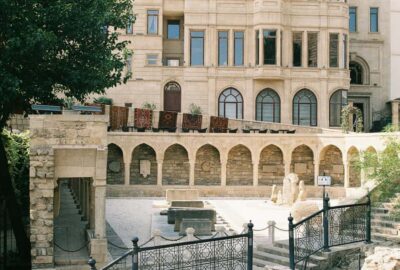
Baku Old City Wonders: A Walking Tour Through Time
Read our review →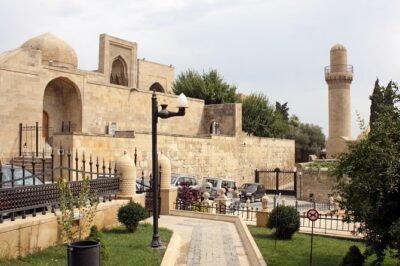
Browse the lists this tour appears in