
Reviewed · GOBUSTAN TOURS
Gobustan and Mud volcanoe GROUP TOUR
Ancient drawings meet bubbling earth. This five-hour Baku day trip links Gobustan’s prehistoric rock art with Azerbaijan’s strange, active mud volcanoes, two sights that are difficult to pair on your own. I like the clear contrast between human history and geology, and I like that round-trip transport removes the hassle of finding remote roads. The main catch is the extra USD 15 ticket fee, which is not included in the USD 52 price.
You start at 9:30 AM in front of Nizami metro station and finish at Fountain Square. Guides such as Valeh, Jale, and Mazhar have been praised for friendly, patient explanations and flexible help. The group may hold up to 30 people, so the experience can feel social rather than private, although some departures have turned into private tours when few people booked.
In This Review
- Key points to know before you book
- Why Gobustan and mud volcanoes make a smart Baku outing
- Starting at Nizami metro station at 9:30 AM
- Gobustan’s interactive museum brings the past into focus
- The open-air rock art site shows 40,000 years of human life
- Mud volcanoes turn the ground into a science lesson
- What the guide adds to the experience
- What the $52 price really covers
- Who should book this half-day tour
- Final verdict: book it for contrast and convenience
- FAQ
- How long does the Gobustan and Mud Volcanoes tour last?
- Where does the tour start?
- Where does the tour finish?
- Is admission included in the $52 price?
- How many people can join the group?
- Can I cancel for a full refund?
Key points to know before you book
- Two very different sights in one morning: Gobustan explains ancient life, while the mud volcanoes show Azerbaijan’s active geology.
- A useful central meeting point: Pickup is in front of Nizami metro station, with drop-off at Fountain Square.
- A strong guide-led experience: Valeh, Jale, and Mazhar are noted for clear explanations, warmth, and patience with questions.
- A rougher second stop: You can climb close to the mud volcano craters, so wear shoes and clothes suited to dirt.
- Budget for the extra fee: The tour costs $52 per person, with a separate ticket fee of $15.
- A good short escape from Baku: The five-hour schedule gives you major sights outside the city without taking a full day.
Why Gobustan and mud volcanoes make a smart Baku outing
Baku has plenty to fill a city stay, from grand boulevards to the old town and the Caspian waterfront. Still, Azerbaijan makes more sense once you leave the capital. This tour gives you a quick look at two features that feel distinctly local: prehistoric carvings cut into rock and mud volcanoes bubbling out of the dry ground.
I like the pairing because neither stop feels like a repeat of what you see in central Baku. Gobustan takes you into the distant human past. The volcanoes shift your attention to the forces beneath the earth. You get culture, archaeology, and geology in a single half-day.
The tour is also practical. Gobustan and the volcanoes are outside the city, and the mud volcanoes can be hard to locate independently. An air-conditioned vehicle and a guide save you from piecing together transport, directions, and site timing.
The advertised price is $52 per person. That is reasonable for a guided outing with transport, especially if you are short on time or do not want to arrange a car. However, you should add the separate USD 15 ticket fee to your mental budget. Lunch is not included, and the schedule is short enough that you should eat before departure or plan for food later in Baku.
More Gobustan rock-art trips from Baku:
- Baku: Gobustan, Mud Volcano, Fire Mount, Temple Lunch Entry
★ 4.9 · 3,246 reviews - BEST Gobustan, Volcanoes & Absheron Fire Tour (Group or Private)
★ 5.0 · 1,254 reviews - Gobustan and Absheron tour (All inclusive)
★ 5.0 · 1,014 reviews
Starting at Nizami metro station at 9:30 AM
The morning begins at 9:30 AM in front of Nizami metro station on Cəfər Cabbarlı küçəsi. This is a central, public-transport-friendly meeting point, which makes the start easier than a pickup at an out-of-the-way office or suburban hotel.
Arrive with enough time to identify the group and settle in. The supplied details do not promise hotel pickup, so you should plan to reach the metro station yourself. At the end, you are dropped at Fountain Square, a useful point for lunch, a walk through central Baku, or a return to your accommodation.
The vehicle is air-conditioned, an important comfort in warm weather. The road time is part of the five-hour total, but the schedule still leaves about two hours for Gobustan and one hour for the volcanoes. That gives you enough time to see both places without turning the outing into an exhausting full-day commitment.
The tour can carry up to 30 people. That capacity matters. A larger group may mean waiting while everyone boards, walks, or gathers around the guide. On the other hand, the group format helps keep the price down. Some departures have had so few bookings that the planned group outing became a private experience, but you should treat that as a pleasant possibility, not a promise.
Gobustan’s interactive museum brings the past into focus
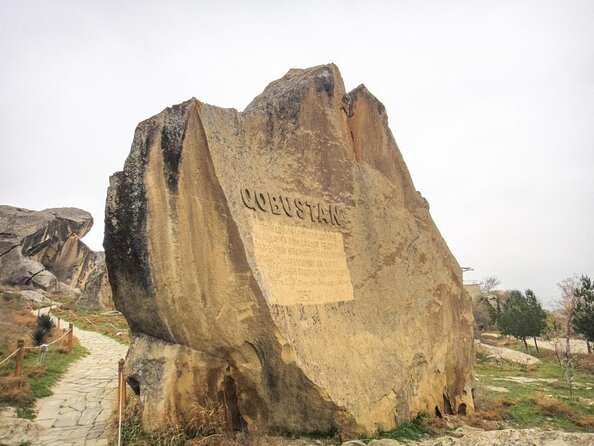
The first major stop is the Gobustan Rock Art Museum. Before you see the carvings outside, the museum gives you a useful introduction to the area, its natural setting, archaeological work, and the people who lived here long ago.
The museum uses touch screens and 3D panoramas to show how people lived between roughly 5,000 and 20,000 years ago. It also includes historical objects dating from about the fourth to the second millennium BC. These displays help you understand the rock art as part of daily life rather than as a collection of isolated marks.
That context is valuable. Petroglyphs can be hard to read when you first encounter them. A guide can point out human figures, animals, hunting scenes, and other details, but the museum gives you a basic frame before you step outside. You begin to see the carvings as clues about movement, work, belief, and survival.
The museum is also a good choice for anyone who likes a little explanation with a major archaeological site. You are not left to stare at weathered stones and guess what you are seeing. Guides named in the tour feedback, including Valeh, Jale, and Mazhar, have been praised for answering questions and adding information beyond the basic route.
Still, keep your expectations realistic. The museum is an interpretive stop, not a large national collection. Its purpose is to prepare you for Gobustan, not to replace the outdoor site. If you have only a short time in the museum, focus on the displays that explain the petroglyphs and the region’s changing environment.
The open-air rock art site shows 40,000 years of human life
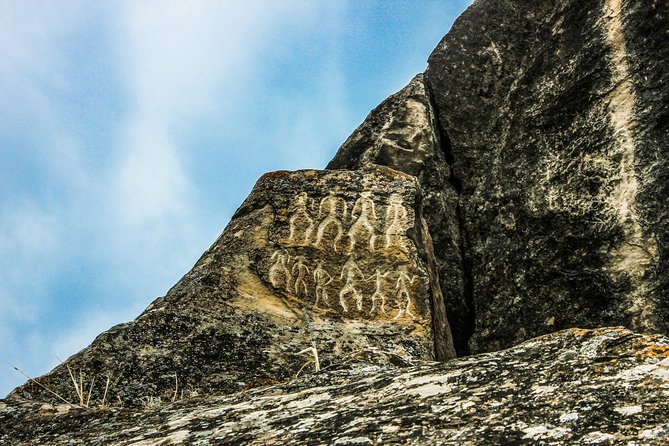
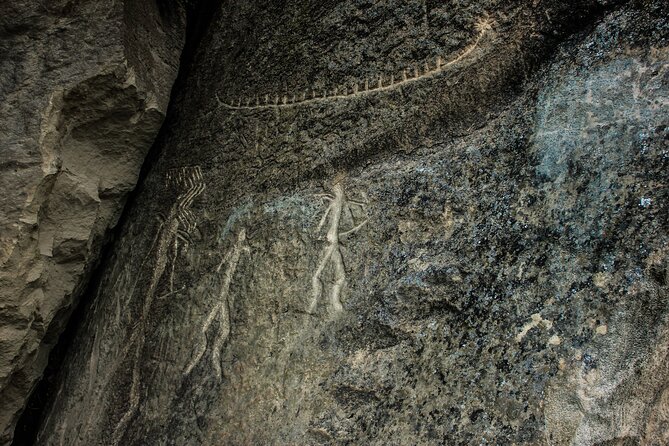
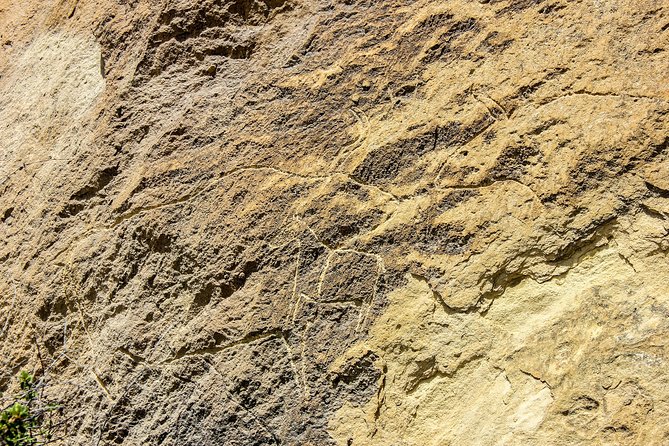
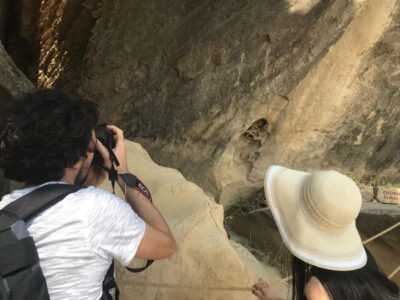
After the indoor visit, the guide takes you to the open-air museum area. This is the emotional center of the tour. Here, the rocks hold petroglyphs said to date back as far as 40,000 years, offering a direct link to people who lived in a very different world.
The drawings are not polished artworks in the modern sense. They are carved into stone, weathered by time, and best understood with help. Look closely, listen to the guide, and give yourself time to notice the outlines. The pleasure comes from realizing that a simple shape may record an animal, a person, a group activity, or a piece of a much older way of life.
I especially like this stop for the questions it raises. Who made the carvings? What did they hunt? Why did they choose certain rocks? What did the images mean to the people who returned to this area over many centuries? The site cannot answer everything, and that is part of its appeal.
The outdoor setting also gives Gobustan a strong sense of place. You see the rock formations around the carvings rather than viewing ancient material behind glass. The connection between people and their surroundings becomes easier to grasp. The region supported human activity for thousands of years, and the stones still carry traces of it.
You should expect walking on uneven ground. The supplied information does not give a detailed accessibility statement, but it says most people can participate. If you have mobility concerns, ask the operator about the outdoor route before booking. Comfortable shoes are sensible, and a hat, water, and sun protection will help on a bright day.
The two-hour Gobustan portion includes the interactive museum and the outdoor site. That is enough for a useful introduction, but not for a slow archaeological study. If you want to examine every carving or read every display, you may wish for more time. For a first visit, the pace is a fair trade for seeing the volcanoes afterward.
A few more Baku trips worth lining up next to this one
- Baku: Guba, Shahdag, Laza & Lunch w/ Free City & Night Tour
★ 4.8 · 1,455 reviews - Shamakhi And Gabala Tour (All inclusive)
★ 5.0 · 815 reviews - From Baku: Gabala and Shamakhi Tour (Free Baku City Tour)
★ 4.8 · 695 reviews - Baku: Candy Cane, Guba, Khinaliq village with Homemade Lunch
★ 4.9 · 519 reviews
Mud volcanoes turn the ground into a science lesson
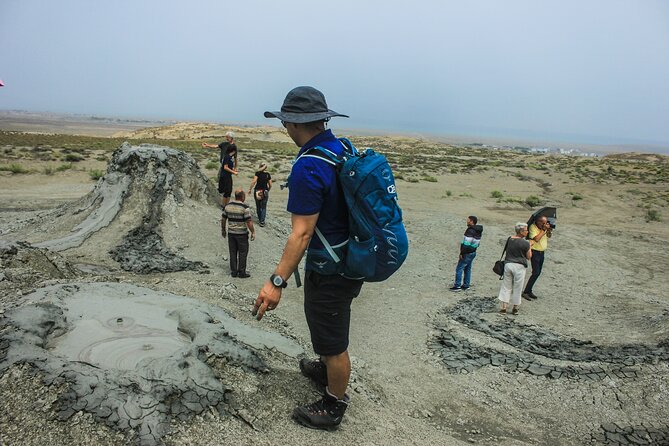
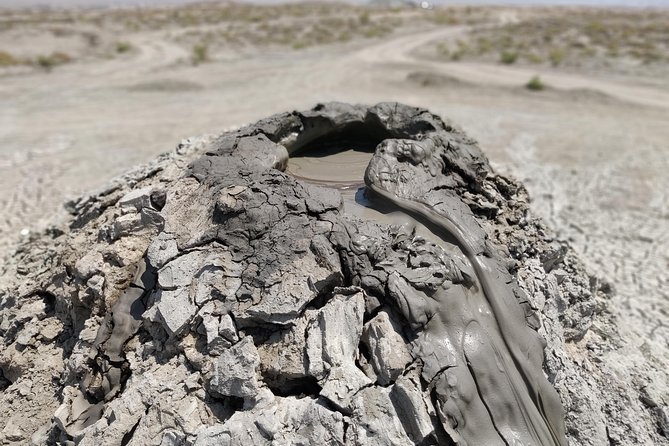
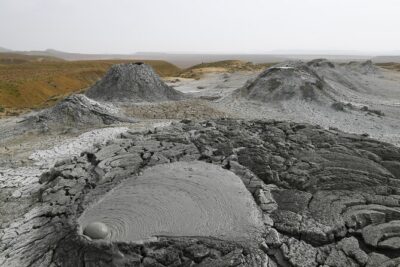
The second stop changes the mood completely. Azerbaijan has about 350 of the world’s roughly 800 mud volcanoes, giving the country an unusually high share of these geological formations. Instead of towering cones of hot lava, you see low mounds and craters where mud and gas bubble, ooze, or push upward.
The volcanoes in this area appeared over a very long period, with the first formations dating back about 25 million years. Their activity makes the site feel strange and alive. The ground is not merely a scenic backdrop. It is part of an ongoing geological process.
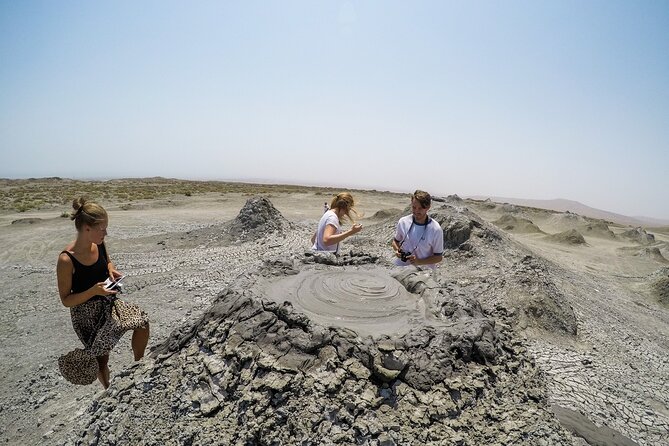
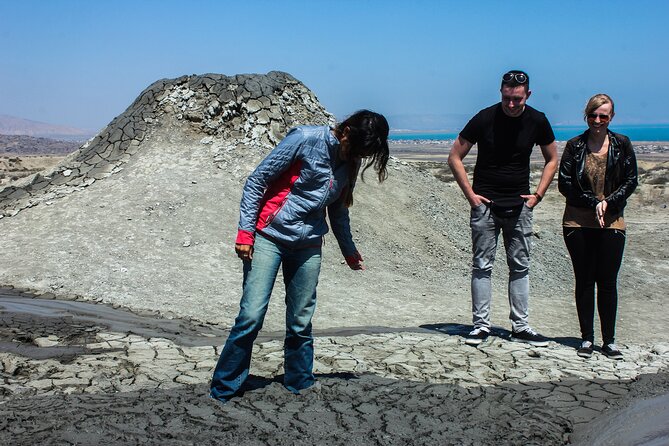
You are taken close to active mud volcanoes and can climb the formations to look into the craters. That close view is the reason organized transport helps. The volcanoes are not an obvious walk from Baku, and reaching the right area without local directions would be difficult.
This stop lasts about one hour. That is enough to see the craters, hear the explanation, take photographs, and enjoy the oddness of the place. It is not a long geological expedition. Think of it as a focused encounter with one of Azerbaijan’s most unusual natural features.
The ground can be rough and dirty. The tour information specifically says you can climb the volcanoes, so choose sturdy shoes rather than delicate city footwear. Keep your phone and camera secure, and be ready for wind, sun, dust, or an uneven surface. The tour requires good weather, so poor conditions can lead to a different date or a refund.
The description also notes that mud and volcanic clay are used in chemical and construction industries, pharmacology, and some forms of treatment for skin, rheumatic, and nervous-system conditions. Treat this as background information, not medical advice. The practical point is that these volcanoes matter beyond their unusual appearance.
What the guide adds to the experience
This is not a sightseeing transfer with a few memorized lines. The guide is central to the experience because both sites need interpretation. A rock carving can look like a scratch without explanation, and a bubbling mud crater can seem like a novelty unless you understand what causes it.
The strongest praise has gone to the guides’ tone as much as their facts. Valeh has been described as friendly and well informed. Jale has been praised for professionalism, patience, and a willingness to answer questions. Mazhar has been remembered as warm, educated, and engaged with his work.
Those details matter because the tour is short. You need someone who can explain clearly without wasting time. A good guide also helps keep the group moving between the museum, outdoor carvings, and volcanoes.
There is some evidence of flexibility, too. One booking was moved to the next day at no extra cost after a scheduling mistake, and one small departure became a private tour. These are useful signs of a responsive local operator, but they should not be treated as guaranteed features of every departure.
The guide’s language ability is also relevant. English-speaking staff and guides are part of the experience described. If you have specific language needs, confirm them when booking, since the tour does not state that every departure offers multiple languages.
What the $52 price really covers
At $52 per person, the tour is priced for convenience. You are paying for an accredited guide, an air-conditioned vehicle, transport from central Baku to two out-of-town sights, and the return to the city center.
The value is strongest if you have only a few days in Azerbaijan. You can see Gobustan and the volcanoes in one morning rather than spending time arranging separate transport. The value is also good for solo visitors, couples, or small groups who would otherwise need to pay for a private car.
The separate USD 15 ticket fee changes the calculation. Your real listed cost is $67 per person before food. Since admission is not included, budget for it in advance and check how the fee is collected. Lunch is also excluded, though the half-day schedule means you can eat after returning to Fountain Square.
The group size can reach 30. If you prefer quiet, slow visits and long photo stops, a private arrangement may suit you better. If you want a lower-cost way to see the main sights outside Baku, the group format makes sense.
Who should book this half-day tour
I would choose this outing if I wanted a broad introduction to the area around Baku without giving up an entire day. It suits first-time visitors, history fans, geology enthusiasts, and anyone who wants something more unusual than another city museum.
It is also a good fit if you are not comfortable navigating remote sites independently. The mud volcanoes, in particular, are easier with a local guide and vehicle. The route gives you a clear plan, central pickup, and city-center drop-off.
Families and mixed-interest groups may like the variety. One person can focus on ancient life, another on outdoor scenery, and another on the volcanoes. Most people can participate, but the outdoor portion requires some walking and climbing, so ask about the route if you need special assistance.
I would hesitate if your main interest is a slow archaeological visit. Two hours at Gobustan includes both the museum and outdoor area, so the schedule is designed for coverage. I would also think twice if you dislike dust, uneven ground, or small-group timing.
The tour has a free cancellation policy up to 24 hours before the start time. Cancellations inside that window are not refunded, and changes are not accepted. Since the outing depends on good weather and a minimum number of participants, the operator may offer another date, another experience, or a full refund if it cannot run.
Final verdict: book it for contrast and convenience
You should book the Gobustan and Mud Volcanoes Group Tour if you want two unusual Azerbaijani sights in a manageable five-hour package. Gobustan is the stronger stop for history, while the volcanoes provide the memorable oddity: bubbling mud, bare ground, and craters you can approach on foot.
The extra $15 fee and group format are the main points to weigh. Add the fee to the $52 price, wear practical shoes, arrive at Nizami metro station early, and do not expect a leisurely private excursion unless the departure happens to be small.
For a first visit to Baku, I think the combination earns its place. The tour gets you beyond the city, gives you useful context, and makes difficult-to-reach sites simple to visit. Choose it for a clear introduction, not for an unhurried archaeological or geological study.
FAQ
How long does the Gobustan and Mud Volcanoes tour last?
The tour lasts approximately five hours. About two hours are allocated to Gobustan and about one hour to the mud volcanoes, with the remaining time used for transport between Baku and the sites.
Where does the tour start?
The tour starts at 9:30 AM in front of Nizami metro station on Cəfər Cabbarlı küçəsi, Bakı 1009, Azerbaijan.
Where does the tour finish?
Drop-off is at Fountain Square in central Baku, at Passage 9VJQ+V42.
Is admission included in the $52 price?
No. A separate ticket fee of USD 15 is listed as not included. Lunch is also not included.
How many people can join the group?
The tour can have a maximum of 30 participants. Some departures may be smaller, but a private tour is not guaranteed.
Can I cancel for a full refund?
Yes, if you cancel at least 24 hours before the experience start time. Cancellations or changes made less than 24 hours in advance are not accepted for a refund. If bad weather or an insufficient number of participants cancels the tour, you are offered another date or experience, or a full refund.
Newest Baku write-ups
- Wine Tour Baku★ 5.0 · 4 reviews
- Wine Crawl Baku★ 5.0 · 2 reviews
- Traditional Azerbaijani Cuisine Workshop★ 5.0 · 5 reviews
- The Magnificent Baku Night Tour★ 5.0 · 3 reviews
- Small-Group Day Trip to Gobustan, Mud Volcanoes, Ateshgah & Yanar Dagh★ 4.5 · 3 reviews
- 2 days tour to Sheki★ 5.0 · 2 reviews
- Sheki tour with overnight★ 5.0 · 5 reviews
- Azerbaijan tour in 2 days/Sheki+Lahij+Gabala up to Georgia Border★ 4.5 · 6 reviews
Gobustan Tours, compared.
Gobustan, Mud Volcano, Fire Mount, Temple Lunch Entry
Read our review →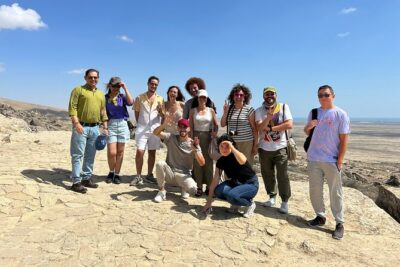
BEST Gobustan, Volcanoes & Absheron Fire Tour (Group or Private)
Read our review →
Gobustan, Volcanoes, Fire Temple and Yanardag Day Trip
Read our review →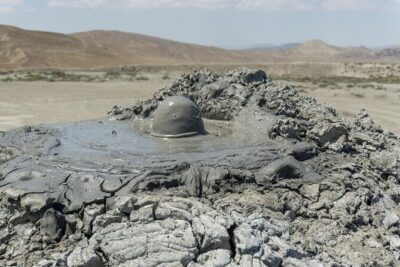
Gobustan & Mud, Fire Temple, Burning Mountain (Group & Private)
Read our review →
Mud Volcan-Fire Temple and Mountain Tour/Entrance inc
Read our review →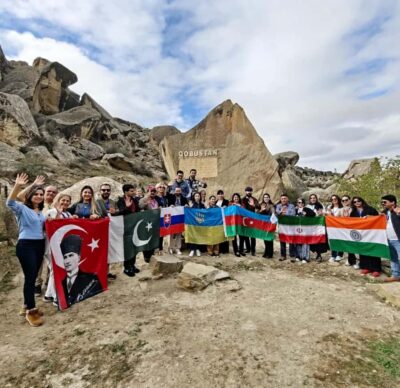
Gobustan Mud Volcanoes Temple & Entry tickets included
Read our review →Browse the lists this tour appears in